a trauma-informed reflection on Exodus, Ch.16 & 17
Sep 17, 2025
0:00
-20:48
This one’s kinda long. So, feel free to listen along as you read or wash dishes or take a walk.
Well, well, well. Here we are again… by God’s grace.
I’ve never had a proper ending with a therapist — until this past Saturday.
Energetically, many things felt like they’d come full circle. As I eagerly await my 30th birthday, I’m in deep reflection mode. Truly, I tell you, these 20s were jam-packed with experiences: the highest of highs and the lowest of lows. Not for nothing, the decade of my adolescence was too. At 18, I was diagnosed with Major Depressive Disorder.
At 22, I packed two suitcases and moved to New York City to pursue my MFA in Creative Writing at The New School. My mother wasn’t admantly against it. In hindisight, she was scared for her child. But in the moment, it was deeply devastating to me. It was 2018. It’s a 2-year program. You do the math… The pandemic upended every single plan I thought I had made for myself, thus sending me into a (deeper) spiral of depression.
Rev. Dr. Kim Wagner, one of my professors from last year, introduced me to the idea of “narrative fracture.” It helped me begin to fully process what exactly I experienced in the mass-trauma-inducing event known as COVID-19.
The loss of narrative temporality combined with the collapse of narrative coherence due to the experience of trauma combine to form an experience of what I call narrative fracture. The word fracture is selected intentionally, since a loss of temporality and coherence causes narratives to fall apart into pieces that no longer find connection or cohesion. When temporality is lost, the interrelationship of past, present, and future are fragmented as the lingering or “eternal” present of the trauma has fractured the interconnection of time. Likewise, when coherence is lost (including comprehensibility, manageability, and meaningfulness), the narrative no longer hangs together in a logical and meaning-making way. The narrative becomes fractured into bits of one’s story that no longer make sense as a cohesive whole.1
As humans, we think in narratives. All of our lives are predicated on stories that we’re told about how the world works, stories of the people we’re “supposed” to be, stories about achievement, respectability, and social relations. They’re all stories.
But, best believe, these ain’t no harmless bedtime stories.
We act out our stories daily. We tell ourselves stories daily. And these stories have very real, material implications.
The story I had fled Mississippi for New York City with was that I was gonna go to New York City to make it. I was going to make a way out of no way. I was going to be a writer. I was going to be a successful writer. I was going to make writer friends. I was going to establish myself as an agent in this world.
Gurl, 2020 shattered those stories to pieces. And baby, did it send me into an unprecedented existential crisis.
I’m so tired of living through unprecedented world events. Is there a pause button on this thing?
So, then, the task of healing — as Dr. Wagner expounds upon in her book, Fractured Ground — was to slowly, sorrowfully, angrily, desperately pick up the broken pieces and somehow reshape the vessel of my personhood.
2020 wasn’t the first time this had happened. I’m a Katrina baby. I’m from the Gulf Coast of Mississippi. Though New Orleans was the focus of the world’s attention, the Gulf Coast was hit pretty much head-on, only we didn’t get the lights and the cameras. Many of us were left with pieces of stories, pieces of the lives we’d once had. I was 9. That’s that age where you start to comprehend, where you start to form your story of how the world works. When Kanye got on TRL and said, “George Bush doesn’t care about Black people,” when I watched the local news stories of people getting stabbed and shot for bags of ice or food rations from the government, when all I saw was blue-tarped rooves of houses around Hattiesburg (some of them in disrepair to this day), my story of the world was irrevocably altered.
A thread of my story of the world became: I am Black. My family is Black. My friends are Black. And we have been left to die by the government. As a Black person, the government doesn’t care about my well-being. I live in the U.S., where the government leaves Black people to die. Fuck this American government. In this world, I have to look out for myself. I cannot trust the government.
That’s some wild shit to realize at the tender age of 9 years old.
Anyway, back to the present:
I had been working with this particular therapist for a little over a year. I found them sometime at the beginning of 2024. The company they worked for took Medicaid. My tenure on unemployment benefits was coming to a close, though I was still hopelessly unemployed. My relationship was on the rocks. The Bronx, where I lived, was still experiencing the highest rates of COVID transmissions in the city.
I live in the U.S., where the government leaves Black people (and the brown people in my neighborhood) to die. Fuck this American government. In this world, I have to look out for myself. I cannot trust the government. The world isn’t kind to people who look like me.
*This post isn’t long enough to get into the gendered and class dimensions of this story, though they are certainly present, but hold that in your awareness.*
That story just kept being reinforced.
A few months into working with this therapist, my relationship ended — I ended it. And I fled, yet again, from New York City to Princeton, New Jersey, of all places. I was accepted and enrolled at Princeton Theological Seminary.
In many ways, my new home brought me the respite that my soul and body needed. It was rural, like my home in Mississippi. It was quiet. And I could walk barefoot in the grass whenever I wanted to. I liked Princeton. I still do. This place has been such a balm for my weary soul — a proverbial “land of milk and honey.”
But I was stuck in the same story. No matter how well I recounted the traumatic details of my life to my therapist (or to anyone, really), they had no way of knowing how deep the trauma went. They had a sense of it, but only I knew how deep the trauma went. Only I had my memories. Only I knew the contours of the cracks in my psyche.
Devotional time led me to Exodus, chapter 16-17. Sometimes, I use the Daily Bread app. Of course, the scripture of the day was a single verse from chapter two, a chapter’s worth of scripture. That’s the thing with any kind of guided scripture tools. It is on the reader to understand the context that surrounds the verse that gets highlighted. The verse highlighted in the app was from chapter 16, v.12. It read, simply: “…then, you shall know that I am God.”
In this passage, the Lord is speaking to Moses, whom we meet in medias res as he leads the people of Israel through the wilderness after they’ve made their great escape from captivity in Egypt.
It’s been just a couple of months since the triumphant exodus. And they are wandering in the desert. Ch . 16, v.1 reads, “The whole congregation of the Israelites set out from Elim and came to the wilderness of Sin, which is between Elim and Sinai, on the fifteenth day of the second month after they had departed from the land of Egypt.”
And the Israelites are already over it. They are complaining to Moses: “If only we had died by the hand of the Lord in the land of Egypt, when we sat by the pots of meat and ate our fill of bread, for you have brought us out into this wilderness to kill this whole assembly with hunger.” (v.3)
Translation: Moses, you dickhead. You talkin’ bout leading us to freedom, but you got us out here starving in this wilderness. We should’ve just died in Egypt. You could’ve just left us where we were at. At least in captivity, we was eatin’ good. Fuck is you talkin’ bout.I bet you don’t even know where tf we goin.’
It’s funny how, on the quest for liberation, there’s a period where one is just fumbling around in the dark. The way to liberation is unruly and uncomfortable. Since we don’t know what a liberated world looks like, we have only our imaginations. All we can know is that, first, we gotta escape captivity. But this is where the trauma-informed lens comes in.
See, during slavery, slave masters often found themselves saddled with the task of “breaking” niggas. That is, quelling any rebellious, insurgent impulses of their captives. In Harriet Beecher Stowe’s Uncle Tom’s Cabin, there’s a minor character of significant note: Scipio, an African-born enslaved man, whom no slave master can seem to break.
Scipio wasn’t fuckin’ with the plantation life. He wasn’t literate. He didn’t know where he was in the world. But he knew that captivity was some bullshit. And my nigga attempts to escape multiple times. Scipio likes to tussle.
The story unfold’s and Scipio is finally apprehended by the plantation owner, St. Clare. But St. Clare takes a different approach with Scipio than the other slave owners. When the other slave owners ask St. Clare how he finally managed to break the unbreakable Scipio, St. Clare responds, “I cared for him.”
St. Clare doesn’t whip or punish him. He isn’t harsh in his words to Scipio. He listens to Scipio, even lets him sleep in his bed, and feeds him well. And in response, Scipio becomes tame and serves his master on that plantation until his dying day.
Stop. Pause. Reflect.
Message: Just because captivity (cough, cough — capitalism) is comfortable, doesn’t mean you’re free.
Like Scipio, the people of Israel had been sufficiently “broken in.” They were eating well in Egypt. Captivity, compared to the desolation of the wilderness and the uncertainty of freedom, seemed far more preferable.
But anyway… back to the matter at hand.
So Moses and Aaron are lookin’ at God like, “Iite bruh, we did what you said. I led ‘em out the land of Egypt - now what?”
And the Lord, in verse 12, responds: “I have heard the complaining of the Israelites; say to them, ‘At twilight you shall eat meat, and in the morning you shall have your fill of bread; then you shall know that I am the Lord your God.”
“In the evening quails came up and covered the camp (the meat), and in the morning there was a layer of dew around the camp. 14 When the layer of dew lifted, there on the surface of the wilderness was a fine flaky substance, as fine as frost on the ground. 15 When the Israelites saw it, they said to one another, “What is it?” Moses said to them, “It is the bread that the Lord has given you to eat. 16 This is what the Lord has commanded: Gather as much of it as each of you needs…” Exodus 16:13-16
Out for an early morning stroll, I caught sight of this peculiar layer of fog. And I imagined that this might look similar to the frost-like manna that covered the ground.
If you know this passage, it’s the part of the story where God rains the manna from Heaven. The manna, as I interpret it, is a symbol of God’s provision in hard times.
Context: Displacement is a traumatizing event. Scholar & theologian Willie Jennings describes the people of Israel as a “diaspora people.” Displacement is their characteristic condition on which the story of the people of Israel is predicated.
Traumatized as they were, the people could not see the blessing and provision that God had provided.
When pastors preach this text, there is often a lot of emphasis placed on the people of Israel’s “disobedience.” They’ll say something like, “See, the people of Israel were disobedient, and God punished them for it.” But that’s a woefully decontextualized rendering of what pastors often talk about as disobedience. It lacks a trauma-informed lens.
The people of Israel are desperate. They are scared. They don’t know where they are or where they’re going. In fact, the people of Israel became so angry with Moses and Aaron’s leadership that they threatened to stone them. (Exodus 17:4)
They “disobey” God by hoarding the limited resources they have. Even though God rains the manna down daily. (Give us Lord our daily bread… y’know, from the Lord’s prayer). Because, like anyone who grew up in poverty — another kind of traumatizing experience — when you don’t know where your next meal is coming from, one can be driven to kill and steal in order to get their needs met.
Of course, out of context, killing and stealing are “bad.” Just like selling dope is “bad,” or robbing someone is “bad.” But in the context of trauma, killing, stealing, and hoarding are survival strategies.
The text tells us that God provided the people of Israel with manna every day for the 40 years they spent wandering in the wilderness, until they arrived at the border of Canaan. Canaan, the land of milk and honey.
And in my own imagination, I can imagine that even once they had made it to Canaan, even once the people of Israel had arrived in the Promised Land, where they could hunger and thirst no more, the trauma of what they’d been through had them stuck in that scarcity mindset. I can imagine that the one’s who’d made it had some survivor’s remorse. I can imagine that some of them didn’t know what to do with the abundance now in front of them. I can imagine that many of them were still stuck in the mindset that they had to kill, steal, and hoard, even though those behaviors were no longer necessary.
If you know the story, you know that the people of Israel’s time in Canaan ended in plague and famine. Because they were “disobedient,” because they were stuck in a collective trauma response, God allegedly “punishes” them, and they are cast into diaspora yet again.
I had a wonderful conversation with my mentor, the director of the Farminary, Dr. Nate Stuckey. Over coffee on a pleasantly mild summer evening, I told him the story of my summer and the calamities and blessings of provision that I had encountered.
Me and Nate
Dear reader, I won’t keep you much longer. Suffice it to say that the theme of this summer, and the theme of my life as I reflect on it now, is provision in the wilderness.
The wilderness being: this capitalist, homophobic, transphobic, patriarchal, anti-black world that I’ve had to navigate as a cash-poor, Black nonbinary queer whose time in the wilderness has accrued an ungodly amount of debt, persistent, chronic pain, and unweildy mental health.
In one of our final sessions, I yelled and screamed and cried at how sad it was that it had taken me this long to realize that I had arrived in my own veritable land of milk and honey, and I was still stuck in a trauma response.
Dear reader, for all intents and purposes, I should be dead by now.
And somehow, I am here to tell you this tale.
I wish I could tell you that I haven’t killed (at least physically), stolen, or hoarded. But the fact is that survival had driven me to desperation. And in my attempts to survive, I have killed relationships. I’ve stolen what I needed. I’ve hoarded the scarce resources I’ve had. I’ve engaged in maladaptive coping behaviors that didn’t serve my highest self.
I yelled and screamed and cried in that penultimate session with my therapist because I didn’t know what else to do. And now, I’m in a place where I can look back and see the carnage in the wake of my desperation.
I mourn for the relationships I’ve injured or compromised. I lament the decisions I made when my back was against the wall. I’m angry with myself for not being the person I envision my highest self to be.
And yet, the power of resurrection and restoration is so profound. I can take joy in the bits of provision that were just enough to keep me alive. I can take solace that, despite my waywardness, there are people in the world who still love me. I can cry happy tears that the possibility of repair, the possibility of healing, is present.
I get to live another day. I get to make different choices. I get to learn to love better. I get to deepen. I get to try again. And for all these things — the good, the bad, and the ugly — I give thanks.
By God’s grace.
Joys and Gratitudes
The Farm
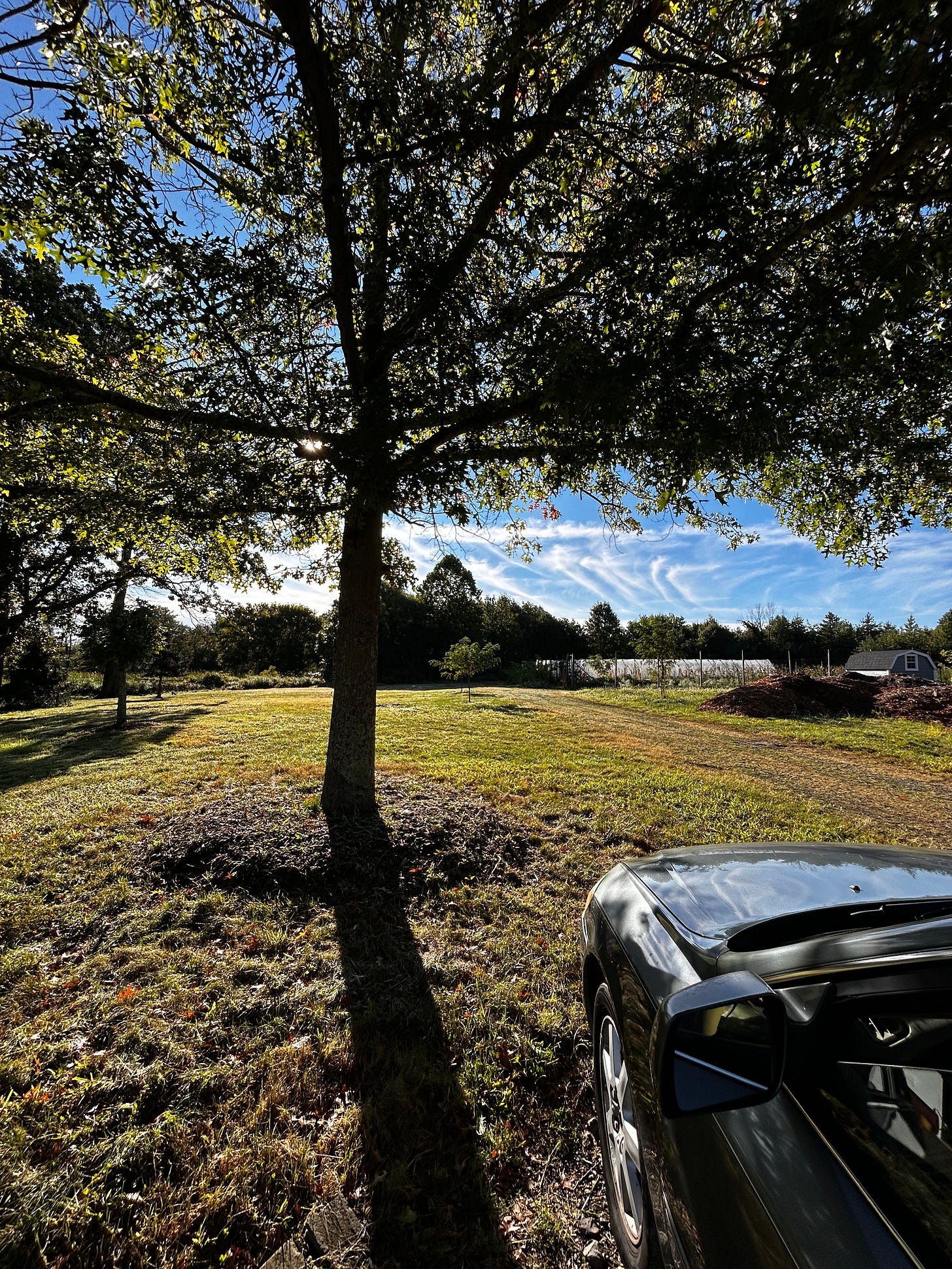
The farm, featuring my car, Bettina, who was given to me as a gift — for the FREE-SKI, no less! *See, small miracles*
Last summer, when I arrived in Princeton and I had to walk in the hot August sun to the Trader Joe’s half a mile away to get groceries (paid for with SNAP), I remember saying to myself, “Next summer, I’m going to have a car.” I didn’t know how. I didn’t know where the money would come from. (Surprise, still no money.)
And yet, provision.
2. Time spent at the farm with some kids from Philly
A group of students from Cristo Rey HS in Philly, discovering the joys of compost
3. Fellowship
Grillmaster Jordan hosted a lil' Labor Day vibe
Benediction
A benediction is an utterance or formula of blessing, good wishes, or a prayer for divine help, often at the end of a religious service or ceremony, invoking divine favor, peace, and blessing on the people or things being blessed. The word comes from Latin words meaning "to speak well of"
New Chance the Rapper!!
Funny enough, Chance and I are about the same age. Though our paths have never converged in this life, there’s a lot of alignment. From 10 Day, to Acid Rap, to Coloring Book, The Big Day (which everybody hated, but I kinda loved), to now, STAR LINE — we’ve been on a similar journey.