
Kwanzaa Reflections Part 2
Day 4-6
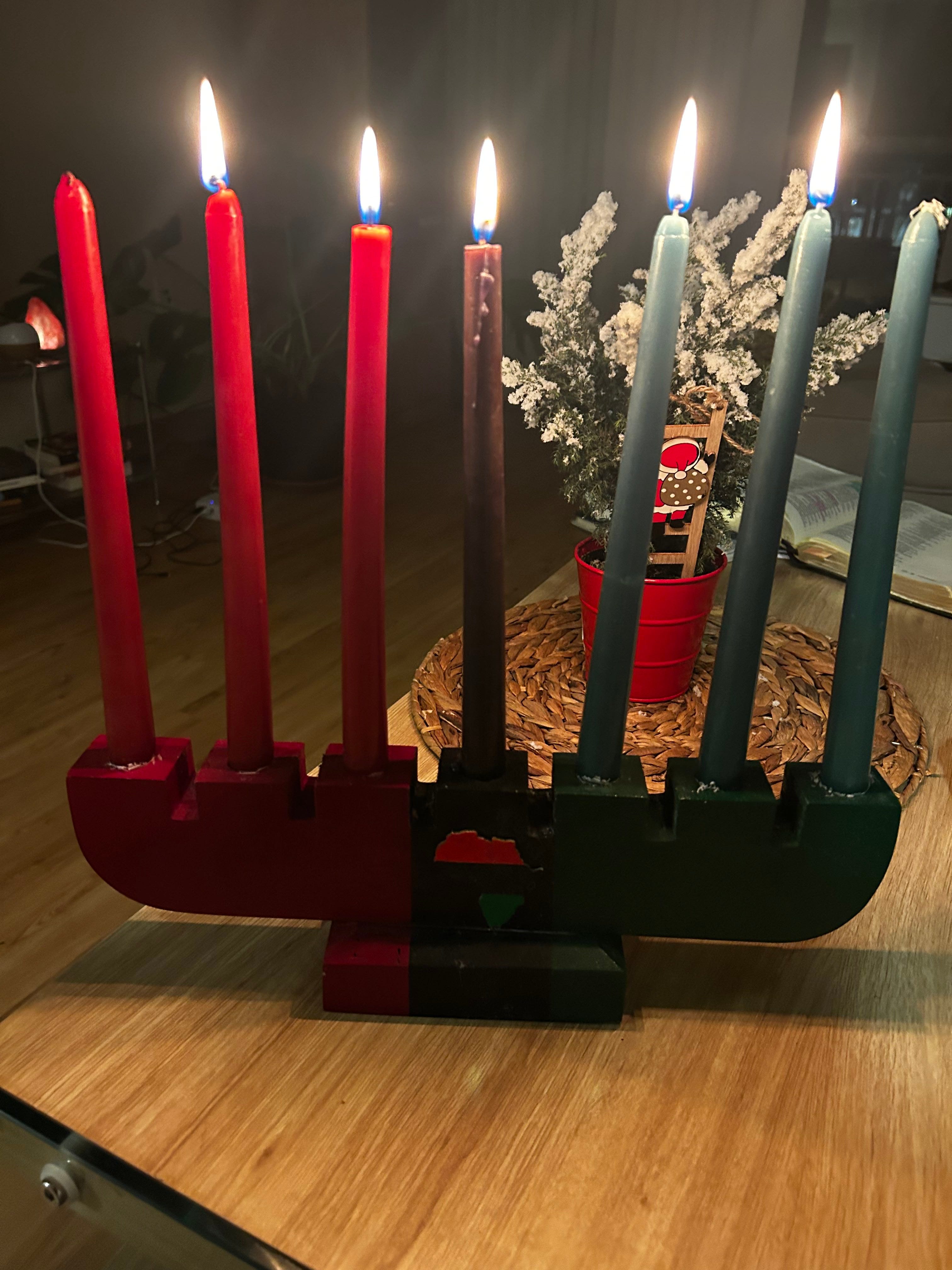
Day 4: Ujamaa (Cooperative Economics)
To build and maintain our own farms/gardens, clinics, and cooperatives to access collective abundance
What is an economy?
An economy is a system of interrelated production and consumption activities that ultimately determine the allocation of resources within a group.
So much of modernity is premised on the idea of scarcity. Look to any American Economics textbook, and Scarcity is the governing principle for how resources are allocated and distributed in “first world” economies. “There is not enough, so we must ration it accordingly.”
Then comes the question of who should get these (scarce) resources and who should get to distribute them. It’s easy to find the answer in history and our present lived experience.
Who gets to lay ownership over the abundant resources that the Earth provides? Who gets the scraps of a capitalist economy? Who are the ones who cannot afford their rent? The ones who don’t have access to fresh produce?
This is the governing ethic of capitalism: to win, someone else must lose.
Beginning to challenge the ideas on which our individuality is based is an invitation of Ujamaa.
Being raised in Black, poor, and working-class households, the idea that we could only count on ourselves for our survival dyed the fabric of our upbringing. We may have internalized that we were not worthy (of happiness, of care, of attention, of love, etc) because of what we could or could not afford, the care we did or did not receive, access to resources, or lack thereof. We may presently, on a subconscious level, locate our value in how much money we can make, or how useful we can be to others (while disregarding our needs and wants), or even other people’s perceptions of us. This is how the psychology of capitalism works.
How can we begin to reprogram our collective psychology towards a win-win ethic?
Perhaps the answer lies in remembering.
Remembering the gift economies of our Black, Indigenous ancestors.
Remembering the collective liberation we find in clothing swaps, potlucks, needle giveaways, condom grabs, and rent parties.
Remembering that we’ve had the tools to save ourselves all along.
2025: Wendell Berry’s essay, Two Economies, drastically shifted the way I think about economy. (Surprise, surprise: I wrote a paper on this, too.) He’s not a theologian, but his writing is often curiously theological. He formulates 5 Principles of what he calls “The Great Economy,” which he also articulates as The Kingdom of God.
The Kingdom of God includes everything.
First, Berry asserts that the Kingdom of God includes everything. He holds this position in contrast to the exclusionary and exploitative nature of the industrial economy. “For the thing that so troubles us about the industrial economy is exactly that it is not comprehensive enough… it tends to destroy what it does not comprehend.” In contrast, Berry represents The Great Economy as encompassing all of creation, within and outside of human comprehension.
The Kingdom of God is orderly.
Berry writes that everything in the Kingdom of God is joined both to it and to everything else that is in it. It poses a foil to the metaphoric idea of “the invisible hand” that supposedly regulates the free-market industrial economy by means of allocating finite resources within the economy. In the kingdom of God, this artifice of scarcity that is foundational to the free-market economy does not exist. This principle also mirrors the Law of Conservation of Energy in the study of Physics. I raise this observation to affirm the validity of Berry’s second principle and further, the idea that greater-than-human creation has mechanisms of moderating itself that may or may not be comprehended by the mechanisms of the industrial economy.
Humanity can never fully grasp the expanse of the Kingdom of God.
The third principle asserts that the tools of industrialization and scientific reasoning are insufficient to comprehend every aspect of creation. The validity of this principle is underscored in Rigby’s Meditations on Creation particularly as it relates to her chapters on Day 3 and 4 that correlate to the creation of Earth’s atmosphere and the creatures the sea, respectively. There is so much and yet still so little that modern science can comprehend of the make-up and composition of both realms of creation.
There are penalties for violating the order of the Kingdom of God.
In conversation with the preceding principles concerning the incomprehensibility of creation, this principle suggests that the self-regulating mechanisms of ecology also work to defend itself from attack. Musing on the significance of what poet William Black called “Satanic wheels”, Berry writes “What had happened… was a fundamental shift in the relation of humankind to the rest of creation… When the wheels of the industrial revolution began to revolve they turned against nature… Of course, what we turn against must turn against us.”
We cannot foresee an end to the Kingdom of God.
Similar to the observations raised under the third principle, the fifth principle rounds out Berry’s formulation of the Great Economy. He offers this analogy: “... the difference between the Great Economy and any human [industrial] economy is pretty much the difference between the goose that laid the golden egg and the golden egg.” The goose, as a living entity within the great economy, and its ability to lay the egg is inherently valuable and contingent on those incomprehensible mechanisms of order keeping of principle two. “To make an egg fully accountable by humans, then, we must make it “golden,” must remove it from life,” which is to say, to cut it off from its relation to the goose that layed it and all the ecological factors that contributed to the egg’s life. Berry argues against the artificial means of valuation constructed within the industrialized economy that is “first abstract and then false, tyrannical, and destructive of real value.”
That fourth principle, the principle of penalties for violation, is the kicker. It seems to me that we are living with the consequences and penalties of many abuses. Of course, there’s much to discuss about who exactly perpetuated the violation and the systemic entities that perpetuate it. But we also have to be accountable for the ways we perpetuate violations and harms to the environment and ourselves daily. Ujamaa reminds us that it was never us humans running the show, yet it’s easy to delude oneself into thinking so. Ujamaa invites us into humility and gratitude for the many hands, feet, seeds, wings, streams, winds, and warmth that work in cooperation to give us what we need.
Day 5: Nia (Purpose)
Definition: To make our collective vocation the building and developing of our community in order to affirm our community’s health, dignity, and humanity
We are significantly powerful and powerfully insignificant.
Where did you lose yourself? It often happens in childhood.
Think about this: when a baby is born, we say “awwww” at every little thing they do. But as they get older, they get told “no” quite a bit. Children’s perceived mischievousness is just their attempt at learning about the world around them, what feels good/doesn’t feel good to them, testing boundaries left and right. The world tells them no out of perceived discipline or respectability. From toddlerhood on, we learn in so many ways that it is not okay.
The idea of purpose can be scary. It seems loaded with responsibility and expectation, causing a sense of existential dread over the thought that one has not “figured out their life’s purpose.”
I know the dread here.
I feel the fear here.
I remember the pain here.
The word vocation - the place where the work that one feels drawn to in their spirit is work that also meets a need of the world around them. In this context, a vocation is not simply a job, but in the words of Audre Lorde, “The aim of each thing we do is to make our lives and the lives of our children more possible. Within the celebration of the erotic in all our endeavors, my work becomes a conscious decision - a longed-for bed which I enter gratefully and from which I rise up empowered.”
The invitation of Nia is tapping into our authenticity and erotic power.
In Audre Lorde’s “Uses of the Erotic,” she invites the reader into a conversation about erotic authenticity. Erotic - which is to say, that animating force that fuels our living, our desires, our survival. The erotic is the seat of our deepest knowing. Without having read, without the influence and input of others, we know what we feel.
Purpose can be scary to think about because it is often represented as something outside ourselves, something we must pursue, something we don't feel. It is a source of anxiety and a feeling that time is running out.
But could it be? You are always right on time, beloved.
2025: I’ve had a sense that my purpose was to tell stories since I was very young. I once fancied myself a griot, a holder of the West African tradition of storytelling. I dabbled in fiction, but the stories I tell always have roots in lived experience and historical/cultural memory.
This year, I became enamoured with Ecowomanist thought and theology, the work of reclaiming and reconstituting historical and cultural memory. I feel called not only to tell new stories, but to excavate the memories and stories of my family and culture, to write them down, and keep them safe, not as some static archival project, but something that also generates new life and new stories.
It’s wild to me that I moved to NYC in 2018 to pursue this writing thing, and it wasn’t until I left that writing as a financially viable vocation seemed more possible. There’s so BIG news coming out in January! I leave you in suspense for now, but this writing dream has definitely been what got me out of bed, even on my hardest days.
Day 6: Kuumba (Creativity)
Definition: To do always as much as we can, in the way we can, to leave our community more beautiful and beneficial than we inherited it.
Invitation
All that you touch
You Change

All that you Change
Changes you.

The only lasting truth
Is Change.

God is Change.

--Octavia Butler, Parable of the Sower
When we look upon the world, it is difficult to ignore the terror, destruction, violence, grief, sorrow, and fear. Living in these queer/trans, Black, Indigenous bodies, we feel these things viscerally. As an old world crumbles before our eyes, as we process through the grief, the violence, the fear, what then becomes possible?
This has always been our way. Remember?
Remember the alchemical magic of the Ring Shout.
Remember the alchemical magic of The Ballroom.
Remember the alchemical magic of Southern Cuisine.
Remember the alchemical magic of our syncretic spiritualities like Voodoo and Santeria.
No matter our suffering, we cannot help but create space to sing, dream, chant, and play together. This ineffable creative spirit is the bedrock of our survival. When they gave us scraps, we prepared them with our love and transformed them into a feast. When they took away our gathering places, we gathered under the sycamore trees, in basements, and in warehouses. When they gave us their religion, we freaked it and made it our own. All that we have touched, we have changed.
We have been changed by community. Changed by love. Changed by trust. Our creativity is the bedrock of our transformation and by extension a transformed world.
What can we create in this time? What is the crude material through which we can co-create a new world?
Can we take the crude material of our relationships to create new ways of relating that would have us moving at the speed of relationship, at the speed of trust? Can we take the overgrown, unkempt flower beds in the vacant lots that scatter our city blocks to create sanctuary and provision for ourselves? Can we take our meager wages and create abundance?
The answer has always been yes. Remember, you are only God playing make-believe with yourself.
2025: I don’t know about y’all, but 2025 (and the last 5 years really) have felt pregnant with possibility. I mean, sure, objectively: shit’s been topsy turvy. From the Administration, to doom-scrolling, and bed-rotting: listen, we cope in the ways we can.
And, the farm has taught me a lot about resurrection from death. Or more accurately, what looks like death. Mentor Nate calls it “the sermon in the compost.”
What is compost? Food scraps, coffee grounds, miscellaneous and discarded organic matter — yes. To the unenlightened, it is trash — waste.
But the farmer and her/his/their wisdom sees the potential; the farmer sees their work as a collaborator with the elements; the farmer does that good, alchemical co-working that, with time and waiting, will generate the fodder of new life.
That’s some holy creativity!
More 2025 Joy


