
Conscious Contact
Addressing the spiritual malady
Bruh… I just knew my summer was about to be ALL THAT. I was planning what functions I was about to hit. I was hype for Pride Month. I even hopped on the apps (read: 1 app) again.
Then I fuck around and break my damn leg. In the first week of Pride month. Matter fact, the morning it happened, I had a date planned later that day. Like bruuuuhhhh. Now, a year ago, this would’ve had me smoking up every day, all day. I mean, the first thing my mind went to was the fact that I was probably about to be out of work for a minute, and folks got bills. Was my insurance going to cover this? How long was I going to be out? How was I going to keep this from my mama? The spiral began…
After the fracture was confirmed at the urgent care, I considered asking the friend who was driving me to make a stop at the smoke shop to get a pre-roll… I thought about it for a good minute, but I ultimately decided not to act on it. Just a few months ago, that would’ve been my immediate reaction to such a momentous inconvenience. It would’ve been just that, an impulsive reaction made from a space of disregulation and anxiety, rather than a reasonable response.
Recovery continues to teach me and help me grow spiritually. There’s a 12-step program for all kinds of stuff, not just substances. Addiction isn’t just about substances; it really comes down to behaviors. Substance use just happens to be a very common, very stigmatized, very obviously maladaptive behavior — most times— with very obvious negative consequences. (And listen, if you’re one of those people that can smoke all day, or even from time to time, and it’s not a problem, that’s wassup. Not yucking anybody’s yum. Hell, it used to be my yum. Do you, boo boo.)
Follow me for a moment: When I say capitalism, I’m not just talking about the economic system. Like yes, it’s an economic system, but our Western brand’s got a little kick to it. It can shape-shift. It’s a tool of political/social organization. It’s a mentality. It's more of a stand-in for a larger epistemological and ontological orientation… which is to say, capitalism as a framework shapes our thinking (epistemology) and our being (ontology). It frames our relationships, our behaviors, our desires, our goals, our futures, our self-image, our very potentiality.
Capitalism hinges on us being addicted to something, whether it be tangibles like work/productivity, money, drugs, relationships, sex, or intangible ideals like perfection, approval, feeling good, looking good, being good… Hell, the tangibles often reflect the intangible beliefs we hold about ourselves and the world.
One of my favorite theologians to think with is Dietrich Bonhoeffer. He’s a fascinating human with a fascinating story. Soldier, Nazi spy, prisoner of war, executed by the German government. I could go on, but I won’t. Suffice it to say, he knew something about the greatest evils and tragedies of this world, and still somehow insisted that there was a God. Anyway, in a collection of lectures he gave that were later compiled into a book called “Creation and Fall: A Theological Exposition of Genesis 1-3,” which is a commentary on the first three chapters of Genesis, he puts forth this argument that the thing that the patristic fathers have called “original sin” is not so much a matter of disobedience but disconnection.
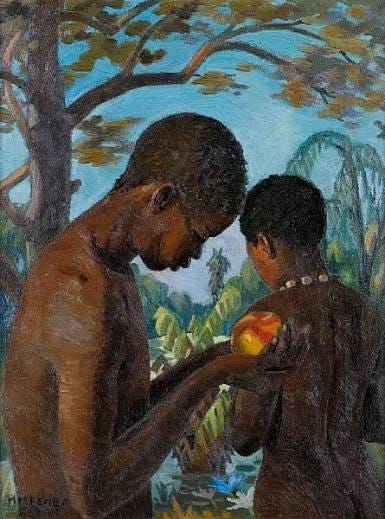
In trying to be “like the Gods” (Genesis 3:5), in the desire “to know”, the desire to possess “the knowledge of good and evil,” in being tempted by the serpent to succumb to the ego, the first spiritual wound was inflicted. Bonhoeffer calls it, “the rejection of one’s creatureliness.” The creature is the creature. God is God. The human was created to be a creature, not God. Though it is cliche, it rings true: EGO - Edging God Out. This is the first spiritual wound from which the human creature’s disconnection from God arises.


The medieval mystic, Hildegard of Benigen, wrote about how the sin of Eve and Adam was that they did not awe enough in the gift that was the Garden. Bonhoeffer, though from a completely different time and place, seems consistent in this line of thought when he talks about how the desire to transcend their limits, their creatureliness – to access the one thing out of that whole abundant garden that God said they couldn’t have access to – was the cause of their being cast out of the garden. For it is only after they eat the fruit, after they give in to temptation and forsake their creaturliness, that they experience shame and unworthiness.
7 At that moment their eyes were opened, and they suddenly felt shame at their nakedness. So they sewed fig leaves together to cover themselves.8 When the cool evening breezes were blowing, the man[a] and his wife heard the Lord God walking about in the garden. So they hid from the Lord God among the trees. 9 Then the Lord God called to the man, “Where are you?” 10 He replied, “I heard you walking in the garden, so I hid. I was afraid because I was naked.” 11 “Who told you that you were naked?” the Lord God asked. “Have you eaten from the tree whose fruit I commanded you not to eat?”
Addiction is just a symptom of the spiritual malady of disconnection from God/Higher Power and from ourselves. The entire Western world seems to suffer from this spiritual malady, this disconnection from self and God. And that wound, left untreated, gives way to the necrotic infection of unworthiness.
So many of us receive messages from a very young age that we are not worthy of the goodness that the world has to offer, not worthy of the goodness and abundance of the garden. We are not worthy to awe, to delight in the goodness of creation. We may not have been told explicitly that we are unworthy, but certain events and circumstances, causes and conditions, have convinced us as much.
… let’s see: Slavery, Reconstruction, redlining, housing projects, war, poverty, the prison-industrial complex, racism, sexism, classism, patriarchy, homophobia, xenophobia, generational trauma… Unfortunately, the list does go on.
Who, or what, told you that you were naked, then? How do we arrive at the conclusion that hiding behind fig leaves will save us? What is the price of hiding? How have we, as a society, come to cope with hiding? Addiction. If not having an addiction in a clinical, disordered substance-use sense, exhibiting addictive tendencies. We thought that overworking, overcommitting, overextending, constantly striving for perfection, constantly seeking approval, constantly seeking acceptance, making more money, checking all the boxes, hitting the milestones, performing more, more, and more — we thought we could hide behind these things, because otherwise we felt naked. And when those things didn’t work out (and sometimes even when they did), some of us reached for the drink or the drug or the sex.
But we are creatures, gifted with grace, and I choose to believe that is something to rejoice in.
Sobriety has put me on a strict spiritual diet of gratitude and humility.
All things considered, I am living the best possible outcome. I have friends who love me and check on me, who bring me food, who wash my dishes and sweep my floors when I can’t stand, who buy me groceries, who sit with me. I have a stable roof over my head. My environment is calm and quiet.
The difference between abstaining from [insert behavior] and recovery has been that recovery means addressing the wound, cutting out the infection, getting down to the specific causes and conditions.
It is painstaking, heartbreaking, Holy work.
Recovery is revolutionary for that reason.
They don’t want us to be sober. They don’t want us to see ourselves as beloved and blessed creatures among the rest of creation. For a long time, I didn’t — not fully.
I have a friend with whom I have a prayer call multiple times a week. We listen to a song. We check in on each other’s souls. We join our hearts for a few moments to be in conscious contact with the God of our understanding. Prayer, meditation, nature walks, singing, attending a place of worship, dancing, listening — this is how I fight back.
This, I think, is part of how we get free.
Beautiful, profound work my friend.
so sorry to hear about your leg friend! but love to see these reflections and the many many ways you’re taking care of yourself through it (and resting with God to take care of you through it too)